

What Is Crankshaft?
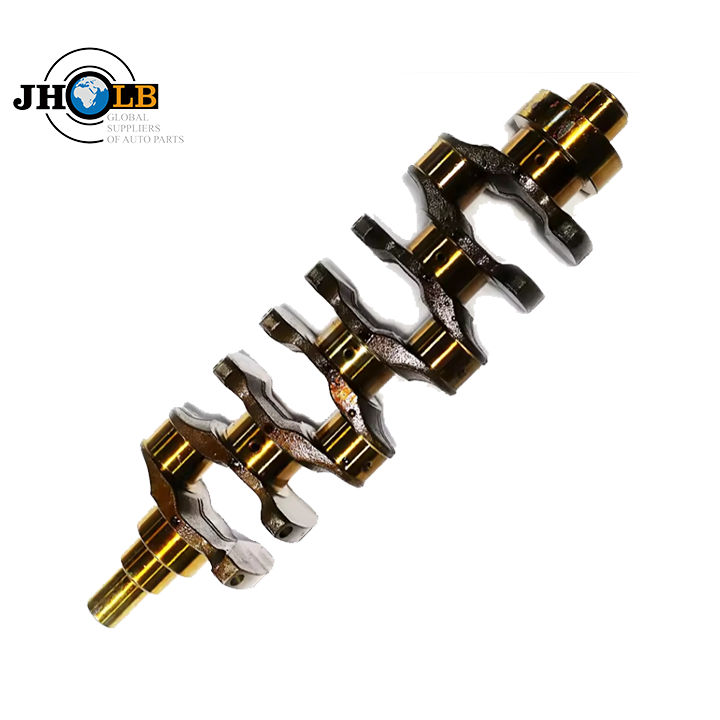
The crankshaft is a rotating shaft containing one or more crankpins,a crucial element in the transmission system, the crankshaft plays a pivotal role by converting the reciprocating motion of the piston into a continuous rotational motion, facilitating the generation of useful power from the piston's back-and-forth movement. Any errors in its design can significantly elevate the risk of engine failure. The crankshaft's significance is underscored by its connection to both the engine and the flywheel, forming an integral link in the machinery's power transmission system.
Advantages of Crankshaft
Improved efficiency
Smooth engine operation
Better torque for improved performance
Increased engine power
-

OEM Crankshaft 13401-54XXX for Toyota Vigo Hilux/HiAce/La...
The design of Crankshaft OEM 13401-54020, as described in the provided evidence, appears to be a sophisticated blend of traditional and advanced manufacturing techniques aimed at enhancing Add to Inquiry -
Toyota Vios 2002-2008 & Yaris 2006-2016 OEM Crankshaft (1...
The OEM 13401-22030 crankshaft's design in terms of material choice and manufacturing processes can be compared to other automotive crankshafts by examining the general trends and specific practices Add to Inquiry


Why Choose Us
Our Factory
Liubei engine factory, located in jinhua, zhejiang, is a leading global provider of automotive power solutions. Since its establishment, we have been committed to designing, manufacturing, and providing innovative, reliable, and efficient engine products, contributing to the development of the automotive industry
One-stop Solution
Strive to build the best one-stop auto parts service platform in china, make auto parts services easier, go further, achieve customers,and achieve ourselves
Advanced Equipment
Our factory is equipped with the most advanced production equipment and automated production lines:
High precision cnc machine tools and machining centers
Intelligent assembly line and robot system
Advanced detection and testing equipment
Environmentally friendly manufacturing process
The application of these devices and technologies ensures that our products reach industry-leading levels in terms of quality, performance, and reliability
Quality Control
We have implemented a comprehensive quality management system, from raw material inspection to final product testing, and every process undergoes strict quality control. Our engine products comply with international standards and have passed multiple rigorous certifications and tests.
Customized Services
We provide personalized accessory recommendations and customization services to ensure that the accessories you choose perfectly match your vehicle model and usage needs
Types of Crankshaft
Fully Built Shaft
A 'fully built shaft' crankshaft has crankpins, main journals, and webs as main components. These parts are usually made using steel casting or forging and are joined together using shrink fitting. This type of crankshaft was common in older engine models but has seen reduced usage due to issues with grain flow and weakness at the joints.
Welded Shaft
This kind of shaft is created by joining multiple parts through welding techniques such as friction welding. In this, parts are pressed together with high-speed rotation to create friction that heats the parts to a plastic-like state and allows them to be forged together.
Forged Crankshaft
They are made by compressing heated steel billets into shape with forging dies. This process creates a uniform grain structure, producing a more robust and durable crankshaft.
Solid Single Piece Crankshaft
They are formed from a single piece of material through forging or casting. Their design can endure the load during firing and cyclic tension, making them suitable for both high-speed and low-speed engines.
Billet crankshaft
Billets are machined from a single solid piece of premium alloy steel. They offer unmatched toughness and are custom-made to match specific project requirements. They are known for their low drag coefficient and are often used in high-performance applications.
Cast crankshaft
Cast crankshafts are produced by pouring molten material, typically cast iron, into a mould to create a raw casting. Due to their less precise grain structure, cast crankshafts may not be suitable for high-performance applications.
Semi-built shaft
This crankshaft is not fully assembled from many parts; crank webs are fully forged and then shrink-fitted to the bearing journal. This process results in a continuous grain structure over the crank web to offer better fatigue strength. You can find them in large marine engines. They are also preferable in modern engines due to their construction advantages.
Application of Crankshaft
Automobile engines
Industrial machinery
Marine engines
Power generators
Aircraft engines
Reciprocating pumps and compressors
Components of Crankshaft
Flywheel Flange:
As the name suggests the flywheel of the vehicle is attached to the crankshaft with the help of a flywheel flange. Flywheel flange is attached to one end of the crankshaft.
It is designed in such a way that it can hold the flywheel rigidly. This is because the flywheel is a heavy mechanical device that rotates at very high rpm.
Pulley End:
The pulley end of the crankshaft is connected to the engine and it can also be connected to the gearbox.
Counterweight:
The counterweight is the most important element of a crankshaft. These help in the smooth running of the crankshaft. When the piston reaches the top dead center the heavier side of the counterweight reaches its lowest point.
And when the piston reaches the bottom dead center the heavier side reaches its highest point. This results in smooth running due to the change of potential energy created by the counterweights.
Balance Weight:
The balance weights are some additional weights that are located in the counterweights to provide improved stability.
Main Bearing Journals:
The main bearing journal has its axis coinciding with the axis of the pulley end and the flywheel flange. These act as the connecting elements between the counterweights. The main bearing journal also forms the axis of rotation for the crankshaft.
Rod Bearing Journals:
The rod-bearing journals are used to connect the piston with the crankshaft. The pistons are attached to the rod-bearing journals with the help of pins.
Oil Passage:
Oil passage is the passage that connects the main journal bearing to the rod journal bearing. The oil from the main journal bearing flows towards the rod journal bearing for lubrication purposes.
Material of Crankshaft
Manganese-molybdenum Steel:
Forged crankshafts, suitable for moderate-duty petrol engines.
Composition: 1.5% manganese, 0.3% molybdenum, 0.38% carbon, and 97.82% iron.
Brinell hardness number: Approximately 250 BHN.
Chromium-molybdenum Steel:
Used in medium and heavy-duty petrol and diesel engines.
Composition: 1.2% chromium, 0.4% molybdenum, 0.3% carbon, with the rest being iron.
Brinell hardness number: Around 280 BHN.
Nickel-chromium-molybdenum Steel:
Ideal for diesel engines with very high fatigue strength.
Composition: 2.5% nickel, 0.31% carbon, 0.65% chromium, 0.5% molybdenum, and the remaining iron.
Brinell hardness number: 300 BHN.
Nodular Cast Iron:
A type of grey cast iron with graphite nodules in a perlite medium, known for high ductility.
Composition: Carbon content around 3-4% and silicon content around 1.8-2.8%.
Brinell hardness number: Approximately 200-300 BHN.
How to Maintain Crankshaft
Proper installation
Prevention for any pre-existing damage that may arise in your crankshaft will depend on the installation process. You can amend any damage even before installation on your connecting rods and main bearing center.
When inserting the bearing caps and bearing shells, always ensure that you maintain the oil bores' cleanliness and the diameters of connecting rod journals and main bearing. Make sure that you appropriately clean the oil ducts in your engine's crankcase with compressed air. Use recommended oils on the sliding surfaces of your bearing shells.
Lubrication
Proper lubrication is needed for the crankshaft to provide turbulent motion. The pressure lubrication comes from the oil pump supplying the lubricant to the pre-drilled passages and holes in the crankshaft journals and axis. The oil level provides splash lubrication in the crankcase and the turbulent motion of the crankshaft.
The oils usually used for lubrication of crankshaft are oxidation restricted circulating oils and rust or engine oils, which incorporate viscosity indicator improvers, oxidation inhibitors, and anti-wear additives to extend the lifespan of the crankshaft.
Don't overfill with oil
Overfilling your crankcase with oil will cause the rise of oil into the crankshaft, which in turn will cause cavitation of the oil. Your engine's oil pump will not circulate properly if your oil has both oil air bubbles. It can cause too much force on the engine components and may cause overheating as well.
Process of Crankshaft
The construction of crankshafts often relies on cast iron because of its excellent durability and ability to withstand the demand of engine operation. In certain cases, crankshafts are also manufactured using forged steel to withstand the heavy load involved.
Cast iron crankshafts are created through a casting process, while forged one involves heating a block of steel until it gets red hot. Subsequently, the forged steel is kept under high pressure to shape it in any desired form.
The manufacturing process of crankshafts also includes surface hardening and heat treatment techniques like carburising, nitriding etc., in order to enhance durability. Lastly, the choice of materials used for crankshaft construction depends on various factors such as operating conditions, the engine’s power output, and more.
How the Crankshaft Works
A crankshaft contains several parts that work in tandem to make a vehicle move. It has crankpins and cranks connected to connecting rods and vibration dampers that help mitigate crank thrusts. Below is a detailed description of how the crankshaft works in a 4-stroke engine.
Downward Motion Of Piston
In the first step, the engine piston moves from the top dead center to the bottom dead center in a downward motion. During this movement, the piston connected to the crankshaft through a connecting rod transfers its motion to it.
Motion Transformation
The next step involves transforming the piston’s linear motion into a rotary motion by the crankshaft. Furthermore, the crankshaft transfers this rotary motion to the camshaft after this transformation.
Compression
The camshaft receiving the rotary motion from the crankshaft facilitates the opening of the inlet valve. As a result, it allows the entry of air-fuel mixture into the engine combustion chamber. With the combustion chamber full, the piston moves from the bottom dead center to the top dead center in an upward motion, compressing the air-fuel mixture.
Also, as the piston moves upwards, the camshaft closes the exhaust and inlet values, completing the compression process. It also completes the first revolution of the crankshaft.
Ignition
The ignition phase is the next phase after the completion of compression. The heat released at the onset of the ignition phase pressures the piston into a downward stroke, also known as a power stroke. As this downward motion progresses, the piston also transfers its linear motion to the connecting rod affixed to the crankshaft.
Flywheel Motion
The crank has two ends, with one end connected to the flywheel. Hence, as the crank receives the linear motion of the piston, it converts it into a rotary motion. Subsequently, the crank transfers this rotary motion to the flywheel, which stores the motion to facilitate vehicular wheel movement.
Exhaust Stroke
This stage ends in the discharge of exhaust gasses from the combustion chamber due to the piston’s downward motion. Here, the camshaft receives the downward motion of the piston, consequently opening the exhaust valve.
Our Factory
Liubei engine factory, located in jinhua, zhejiang, is a leading global provider of automotive power solutions. Since its establishment, we have been committed to designing, manufacturing, and providing innovative, reliable, and efficient engine products, contributing to the development of the automotive industry.
We firmly believe that the engine is the heart of a car, driving every journey. Our mission is to provide excellent engine products and services to global customers through continuous technological innovation and process improvement, while committed to environmental sustainability.


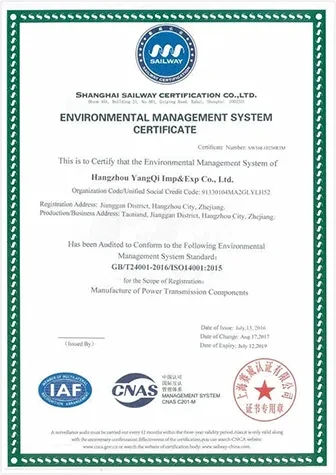
Our Certificate
Our company has become one of the most competitive companies in the field of automotive engine parts, and has obtained iso/ts16949:2009 quality system certification


FAQ
As one of the leading crankshaft manufacturers and suppliers in China, we warmly welcome you to buy high-grade crankshaft in stock here from our factory. All auto parts are with high quality and competitive price.
crankshaft machining tolerances, crankshaft inspection, crankshaft balance